


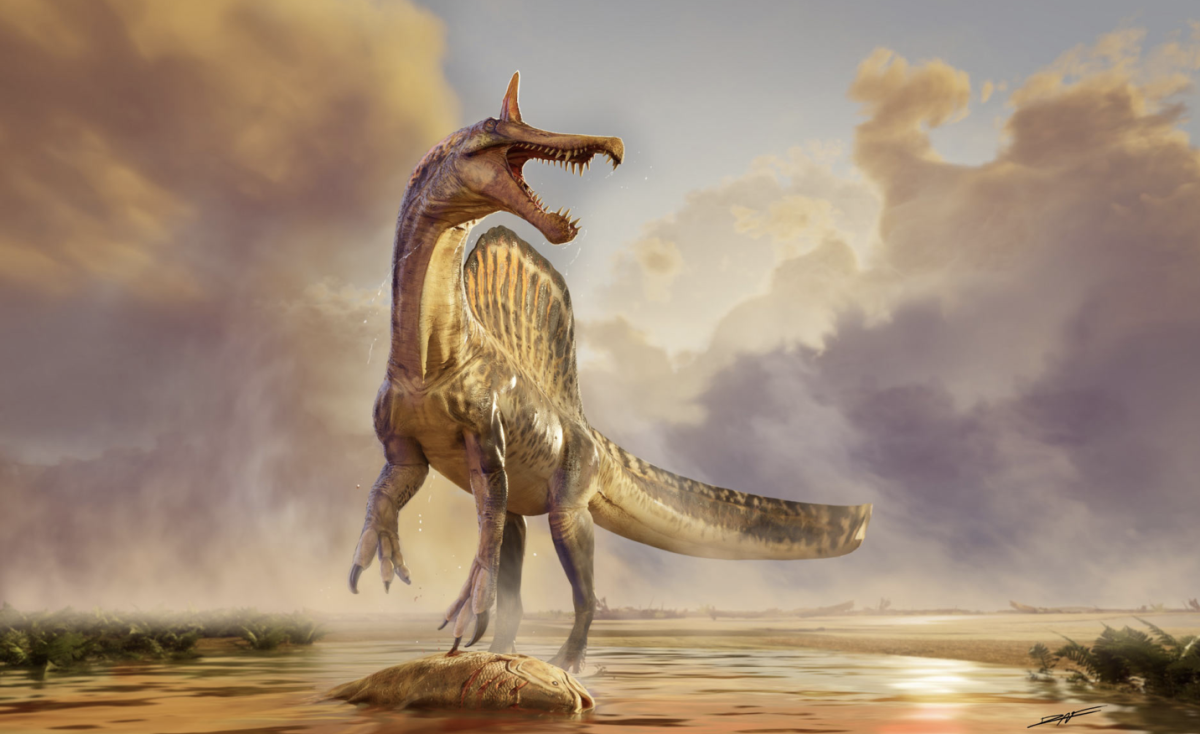
A team led by University of Chicago paleontologist Paul Sereno found a new species of Spinosaurid in the Sahara Desert after 100 years of no new species being discovered.
The new Spinosaurid species, Spinosaurus Mirabilis, was initially discovered in 2019, with follow-up excavations at the site in 2022. Recently, researchers deemed it a whole new species after fully unearthing the specimen on February 19, 2026. However, this dinosaur does’t reveal more information about the species because scientist say moe complete fossils are needed to better understand the specimens.
The first skeleton of this Spinosaurid was discovered in the Saharah Desert in Niger. What is now the Saharah Desert was once a marshland thriving with prehistoric life. 95 million years ago this marshland was where the Spinosaurus Mirabilis lived and hunted large fish for its food. Its feeding techniques and habits are believed to resemble that of a heron, a species of birds that have long necks and wade through water.
Spinosaurus Mirabilis was a dinosaur that lived during the Cretaceous period 95 million years ago. This dinosaur was found to be bigger than originally thought, measuring almost 40 feet long and weighing around seven tons. Despite popular belief, Spinosaurus Mirabilis was not aquatic and was found to be a poor swimmer in its costal habitat. The feature that differentiates these Spinosaurids from others is the scimitar-shaped bone crests that are covered in a protective keratin on the top of its head.
A science teacher from Griffith High School, Teresa Cooper, had this to say on the discovery’s contribution to the scientific community.
“I think it is nice from an environmental science perspective to understand biodiversity from the past, and it just helps highlight how many different species there were alive back then,” Cooper said.
The first skeleton of this Spinosaurid was discovered in the Saharah Desert in Niger. What is now the Saharah Desert was once a marshland thriving with prehistoric life. 95 million years ago this marshland was where the Spinosaurus Mirabilis lived and hunted large fish for its food. Its feeding techniques and habits are believed to resemble that of a heron.
Sophomore Benecio Baez gave his opinion on the discovery of the new Spinosaurid.
“I think that it’s really cool and isn’t what I expected them to find,” Baez said.